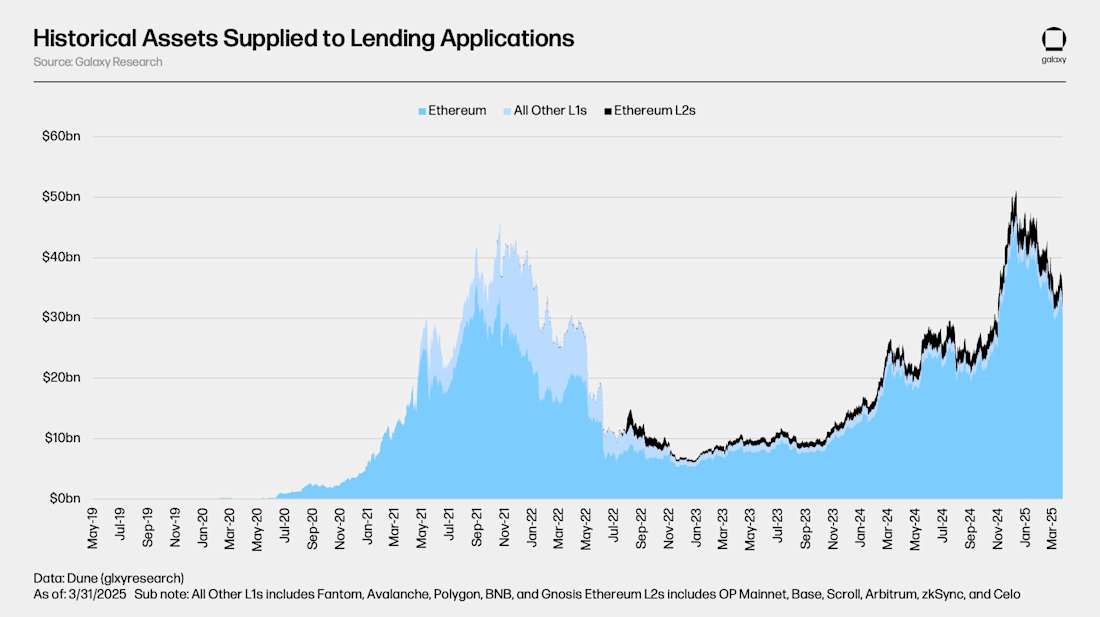
The onchain crypto loan market hits record highs
Onchain lending has moved from a niche experiment to a core pillar of the crypto economy. At the end of the third quarter of 2025, crypto-collateralized lending reached an all-time high of $73.59 billion, according to Galaxy Research. This milestone marks a significant departure from the sector’s lows during the bear market, where open borrows bottomed out at just $1.8 billion.
The momentum has not slowed since that trough. Usage continued to climb, reaching further all-time high levels in December 2024, as reported by Coinbase Institutional. This sustained growth suggests that the current cycle is driven by structural adoption rather than speculative fleeting interest. The sector is maturing, with liquidity deepening and protocols becoming more resilient to market volatility.
To understand the scale of this expansion, it helps to look at the trajectory of total value locked in lending protocols. The chart below illustrates the recovery and subsequent surge in open borrows over the last two years.
This growth reflects a broader shift in how capital is deployed. Lenders are increasingly comfortable locking up assets in decentralized finance (DeFi) protocols, while borrowers are leveraging onchain credit lines for everything from arbitrage to yield farming. The infrastructure supporting these transactions has also improved, reducing the friction and risk that once plagued the market.
As the market cap of onchain loans continues to expand, the focus is shifting toward efficiency and security. The record-breaking figures are not just a testament to past performance but a signal of the sector’s capacity to handle significant volumes. This maturity sets the stage for more sophisticated financial products and broader institutional participation in the years to come.
Onchain vs centralized loan costs
When comparing borrowing options, onchain stablecoin loans generally offer lower interest rates than both centralized crypto platforms and traditional personal loans. According to Aave Labs, on-chain stablecoin borrow costs have averaged 4–6% over the last 12 months. This is notably lower than the 8–12% typical for centralized crypto-backed loans and the ~10%+ often seen in personal loans.
The cost advantage comes from the direct peer-to-peer nature of onchain lending, which removes the overhead of traditional financial intermediaries. However, this efficiency requires users to manage their own collateral and understand smart contract risks.
| Lender Type | Avg. Interest Rate | Primary Risk | Accessibility |
|---|---|---|---|
| Onchain (DeFi) | 4–6% | Smart contract vulnerability | Global, 24/7 |
| Centralized Crypto | 8–12% | Platform insolvency | KYC required |
| Traditional Personal Loan | 10–20% | Credit score impact | Credit history required |
The trade-off is clear: you save on interest but assume more technical responsibility. Centralized platforms charge more for convenience and customer support, while personal loans offer no crypto exposure but require strict credit checks.


As an Amazon Associate, we may earn from qualifying purchases.
Infrastructure and collateral types
Use this section to make the Onchain Crypto Loan Market Research decision easier to compare in real life, not just on paper. Start with the reader's actual constraint, then separate must-have requirements from details that are merely nice to have. A practical choice should survive normal use, maintenance, timing, and budget. If a recommendation only works in an ideal situation, call that out plainly and give the reader a fallback path.
The simplest way to use this section is to write down the must-have criteria first, then compare each option against those criteria before weighing nice-to-have features.
Tools and platforms for lenders
Use this section to make the Onchain Crypto Loan Market Research decision easier to compare in real life, not just on paper. Start with the reader's actual constraint, then separate must-have requirements from details that are merely nice to have. A practical choice should survive normal use, maintenance, timing, and budget. If a recommendation only works in an ideal situation, call that out plainly and give the reader a fallback path.
The simplest way to use this section is to write down the must-have criteria first, then compare each option against those criteria before weighing nice-to-have features.
Risks and strategic considerations
Onchain lending offers speed and accessibility, but the underlying market structure remains fragile. During the last bull market, institutional crypto lending grew rapidly, often relying on complex, opaque leverage that amplified losses when markets turned [src-serp-6]. The current environment, with total market capitalization around $30.87 billion, demands a more cautious approach to capital allocation [src-serp-6].
The primary risks fall into three categories: smart contract vulnerability, liquidation cascades, and concentration risk. Unlike traditional finance, where bailouts or regulatory interventions can stabilize markets, onchain protocols are bound by their code. A single exploit or a sudden drop in collateral value can trigger automated liquidations, wiping out user funds without recourse.
| Risk Factor | Impact Level | Mitigation Strategy |
|---|---|---|
| Smart Contract Exploit | High | Use audited, battle-tested protocols with large TVL. |
| Liquidation Cascade | High | Maintain low loan-to-value (LTV) ratios. |
| Counterparty Concentration | Medium | Diversify across multiple lending platforms. |
| Regulatory Uncertainty | Medium | Monitor jurisdictional changes for your assets. |
Strategic decision-making requires understanding your specific use case. For short-term liquidity needs, over-collateralized loans on established platforms offer safety but at a higher cost. For yield generation, uncollateralized or semi-collateralized lending carries significantly higher risk of total loss. Always prioritize protocol transparency and historical stability over promotional yields.
Before deploying capital, ensure you have a clear exit strategy. The onchain lending market is not immune to black swan events. Treat these positions as high-risk components of a broader portfolio, not as safe havens for your core holdings.
No comments yet. Be the first to share your thoughts!