The Shift to Institutional Onchain Lending
Onchain lending has graduated from a crypto-native curiosity to a serious infrastructure play. What began as simple overcollateralized DeFi protocols is now expanding into private credit arrangements that mirror traditional finance. Major players like Cantor Fitzgerald and Apollo Global Management are extending credit facilities through blockchain protocols, signaling a clear shift toward institutional-grade infrastructure.
This evolution is driven by the demand for onchain private credit, which allows users to pool funds and deploy them through offchain agreements. Unlike standard DeFi money markets that typically require 150% crypto collateral, these new models often secure loans with offchain assets or the borrower's creditworthiness. This flexibility opens the door to larger, more complex borrowing needs that pure DeFi cannot easily support.
AI plays a pivotal role in this transition by enhancing risk assessment. As lenders move off the pure collateral model, they need sophisticated tools to evaluate borrower reliability and offchain asset value. AI-driven analytics allow protocols to price risk more accurately, making onchain lending viable for a broader range of institutional borrowers.
The underlying asset volatility remains a critical factor. Lenders must monitor the health of the collateral closely to maintain loan-to-value ratios. The chart below illustrates the volatility of ETH/USDC, a common collateral pair, highlighting why real-time risk monitoring is essential in this space.
The technical stack behind onchain lending
Onchain crypto loans rely on three specific infrastructure layers: oracles for price data, credit scoring models for risk assessment, and liquidity pools for capital deployment. Unlike traditional banking, these systems operate autonomously on the blockchain, requiring precise coordination between real-world data and smart contract logic.
Oracles and price feeds
Price oracles act as the bridge between offchain market data and onchain contracts. They provide the real-time asset prices necessary to calculate loan-to-value (LTV) ratios and trigger liquidations. Without accurate, tamper-proof price feeds, lending protocols cannot function safely. Leading protocols like Chainlink provide decentralized oracle networks that aggregate data from multiple sources to prevent manipulation and ensure the integrity of lending positions.
AI-driven credit scoring
Traditional DeFi lending requires over-collateralization, often demanding 150% or more of the loan value in crypto assets. Onchain private credit changes this by incorporating offchain assets and borrower creditworthiness. Platforms are increasingly using AI-driven credit scores to assess risk beyond just onchain transaction history. These scores analyze offchain financial data, allowing lenders to offer uncollateralized or undercollateralized loans to borrowers with strong credit profiles. This shift expands access to capital for institutions and high-net-worth individuals who may not want to lock up their crypto assets.
Liquidity pools and capital efficiency
Liquidity pools serve as the source of funds for these loans. In traditional DeFi, lenders provide capital to money market protocols like Aave or Compound. In the onchain private credit space, platforms like Morpho allow lenders to offer rates directly to borrowers, bypassing some of the inefficiencies of standard pools. This peer-to-peer lending model can improve capital efficiency and yield for lenders while offering better terms for borrowers. The integration of these layers creates a robust infrastructure that supports both secured and unsecured onchain borrowing.

| Feature | Traditional DeFi | Onchain Private Credit |
|---|---|---|
| Collateral | Crypto assets (150%+) | Offchain assets or credit score |
| Risk Assessment | Onchain transaction history | AI-driven credit scoring |
| Liquidity Source | Standard money market pools | Direct peer-to-peer or specialized pools |
Key protocols in the lending market
The onchain lending landscape has shifted from a monolithic model to a fragmented ecosystem of specialized protocols. Borrowers and lenders now choose platforms based on their specific needs for collateral types, interest rate flexibility, and custody requirements. Understanding the distinction between centralized exchanges, decentralized money markets, and peer-to-peer networks is essential for executing a secure loan strategy.
Centralized and Hybrid Lending Platforms
Centralized exchanges (CEXs) remain the most accessible entry point for crypto-backed loans, offering a familiar user experience and instant liquidity. Coinbase, for instance, allows users to borrow against their crypto holdings in USDC while retaining ownership of their underlying assets. These loans are often powered by underlying decentralized infrastructure, such as Morpho, blending the ease of a centralized interface with the transparency of onchain settlement. This hybrid approach reduces friction for institutional and retail users who prioritize speed and regulatory clarity over full self-custody.
Decentralized Money Markets
Decentralized finance (DeFi) protocols like Aave and Compound dominate the open lending market, enabling permissionless borrowing and lending through smart contracts. These platforms operate as non-custodial money markets where users supply assets to earn yield and others borrow against collateral. The interest rates are algorithmically determined by supply and demand dynamics. While these protocols offer the highest transparency and composability, they require users to manage their own keys and understand the risks associated with smart contract vulnerabilities and liquidation mechanisms.
Peer-to-Peer and Private Lending
For borrowers seeking more flexible terms or larger loan-to-value (LTV) ratios, peer-to-peer (P2P) and private lending platforms offer an alternative. Protocols like Goldfinch and Maple Finance facilitate loans between institutions or accredited investors, often bypassing the strict over-collateralization requirements of standard DeFi. These platforms may use offchain credit assessments or onchain reputation systems to underwrite loans. This model is particularly relevant for businesses that hold illiquid assets or require larger capital injections than typical DeFi protocols support.
Market Context and Rates
Lending rates fluctuate based on market demand and the specific assets involved. Stablecoin lending, for example, often offers lower yields compared to volatile assets like Bitcoin or Ethereum, reflecting the lower risk profile. Monitoring live market data helps borrowers time their entries and lenders identify optimal yield opportunities.
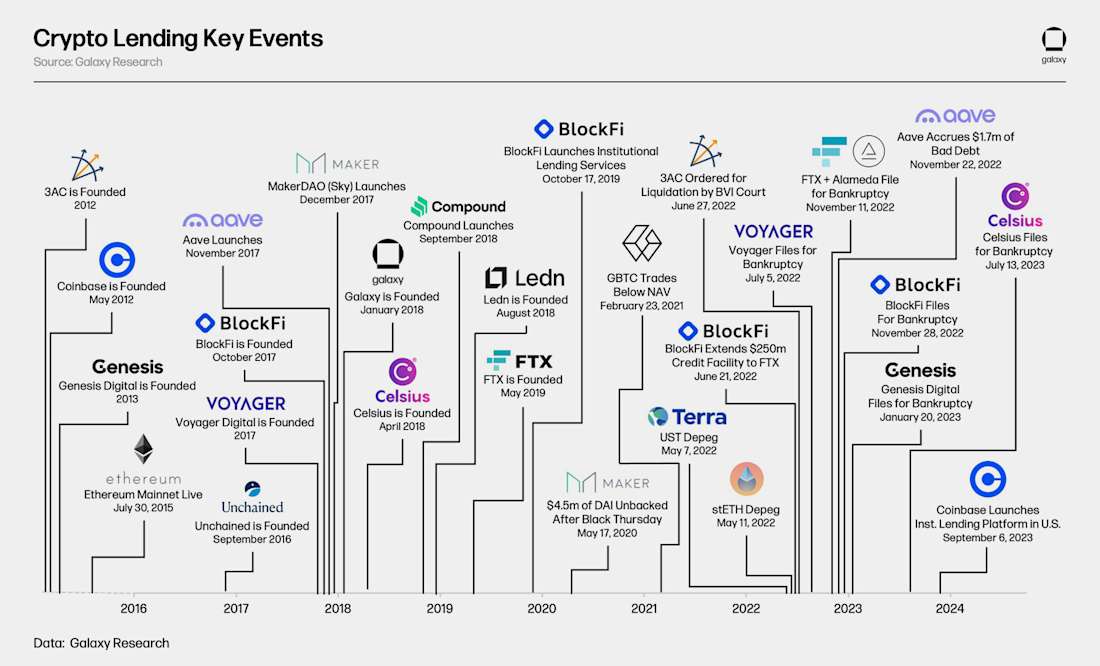
Choosing the right protocol depends on your risk tolerance, asset type, and need for custody. Centralized platforms offer simplicity, DeFi protocols offer transparency, and P2P networks offer flexibility. Evaluating each against your specific loan strategy ensures you secure the best terms while maintaining security.
Navigating Yield Risks and Volatility
Building a yield strategy on crypto loans requires more than chasing the highest APR. The mechanics of onchain lending introduce specific frictions that can erode returns or trigger sudden losses. You must weigh the stability of the underlying asset against the volatility of the interest rate and the liquidity of the collateral.
Liquidation Mechanics and Over-Collateralization
The most immediate risk in DeFi lending is liquidation. When the value of your collateral drops below the protocol's health factor, automated scripts sell it off, often at a discount. This is why over-collateralization is standard; it acts as a buffer against market swings. However, in highly volatile markets, even a 150% collateralization ratio can vanish in minutes during a flash crash.
Onchain private credit offers an alternative path. Unlike standard DeFi money markets, private credit often extends credit without the heavy 150% crypto-collateral requirement, instead relying on offchain assets or borrower creditworthiness. This reduces the risk of automated liquidation but introduces counterparty risk, as you are trusting an offchain agreement rather than a smart contract's immutable code.
Interest Rate Volatility
Yield is not static. Lending rates fluctuate based on supply and demand, often spiking during periods of high leverage. A rate of 20% APY today might drop to 5% tomorrow if liquidity dries up. To manage this, diversify across multiple protocols and asset classes. Do not lock your entire portfolio into a single high-yield position that relies on perpetual market conditions.
Strategic Asset Selection
Choose collateral that aligns with your risk tolerance. Stablecoins offer lower volatility but often lower yields. Volatile assets like ETH or BTC offer higher potential yields but require active management to avoid liquidation. Consider using a TechnicalChart to analyze historical volatility patterns before locking in long-term positions.
The goal is not to eliminate risk, but to price it accurately. If the yield does not compensate for the potential loss of principal due to liquidation or rate drops, the strategy is flawed. Always prioritize capital preservation over aggressive yield chasing.
No comments yet. Be the first to share your thoughts!